Posted on

From the Editor’s Desk: A Guide to Dialogue

Editors can tweak your formatting, but it certainly makes it easier when you do some of the work beforehand—especially for dialogue.

  • Every time a new person speaks, indent on a new line: 

“What are you doing?” Samantha asked. 

“Rearranging matches,” Sebastian said, boredom seeping through his voice.  

“Why?” Samantha inquired. 

“I have no idea,” Sebastian admitted. 

  • When a character speaks both before and after an interjection, the punctuation should follow like this:

“You never have any idea,” Samantha sneered. “That’s why I’m leaving you.”

“You can’t leave me,” Sebastian replied, “because if you do, who will organize your things?” 

  • If there is more text beyond the conversation, it can stay in the same paragraph:

Samantha glared at him. “I don’t need anyone to organize my things,” she snapped. “I was just fine in my organizational skills before you came along. I don’t need someone to look after me like a child.” She scanned the library, haughty eyes taking in other annoying details of his obsessive behavior. 

“Huh,” Sebastian scoffed. “You couldn’t tell that from where I was standing, dear.” He turned away from his latest project to stare at her. As usual, her clothes were in disarray, her wrinkled pants and untucked shirt almost screaming her need for his guidance. “Come here, Sam. You look a mess.” 

“You could use a good mess!” Samantha shouted, stalking out of the library. 

  • All periods, commas, question marks, and exclamation points go inside the quotation marks.
  • You should never put “double” “quotation” “marks” next to one another unless you are making a list of quoted items—otherwise, “double quotation marks” is sufficient.
    • As I recall, you told me, “I am busy,” “I have plans,” and finally, “I am dead. Please leave a message” the last time we talked about this.  

Review the Rules

  1. If you start a sentence with dialogue, capitalize the first letter of the spoken words, but leave the rest in lowercase (except proper names). Put a comma at the end of the spoken words (inside the quotation marks) if it’s not a question or exclamation point. 

“I don’t know why you do this to me,” Sebastian pondered. He stared at the books lining the walls, face blank while his thoughts raced. “It’s only matches,” he whispered. 

  1. If you start with the tag line, you should start the actual spoken words with a capital letter. Put a comma (if it’s not a question/exclamation) after the verb and before the first quotation mark.

Sebastian said, “She’ll be back.”

  1. If you interrupt a complete sentence with a tag, do not capitalize the words after the tag. If you have two separate sentences with a tag ending the first one, capitalize the second sentence.  

“I know she will forgive me,” he moaned, “eventually.” He glanced at the door, suddenly sure he heard her returning footsteps. “She’s coming back,” he whispered. “I know it.”

  1. If the spoken words are not a statement, put the question mark or exclamation point inside the quotation mark (as long as the spoken words are a question/exclamation). If the entire sentence is a question or exclamation, then put the marks outside the quotation mark. 

“Why do I put up with him?” she wondered, staring down the long hallway. “He’s such jerk!” she snapped, hands fisting at her sides. “Those matches,” she mused, shaking her head, “make me absolutely crazy.” How dare he say she looked “a mess”? “It’s only matches” indeed!

  1. Unspoken thoughts should be italicized to distinguish them from spoken words. 

Just one more box, Sebastian thought, emptying the matches onto the table. 

Let’s get weird for a moment–take a sneak peek at the 4 Horsemen Publications guidelines for formatting weird communication! 

A Quick Look at 4HP Standards for different forms of communication

“Normal dialogue looks like this.”

  • It should be indented and start a new paragraph every time a different character speaks.

“<If you have characters speaking aloud in a language that is not English/common, but it is shown in English for the readers, use these to show that.>”

  • Single quotes with this situation: “<How do you say it? ‘I am tending to her wounds.’>”
  • The only time to use single quotes is inside double quotes (a quote within a quote).

Internal thoughts are italicized and are always in present tense.

<If characters are thinking directly to one another using telepathy, use italics inside these.>

<<If the characters are using non-English telepathy, use italics inside doubles.>>

<If you characters use a non-standard language of communication, just put it inside these.>

  • Example: snakes hissing but still communicating; they understand one another. 

“If your characters can hear a TV or radio broadcast, use italics inside quotation marks.”

  • Phone conversations are treated as normal conversations–no need for italics. 
  • Sign language is a language–just use quotes to show communication like regular dialogue.

Use italics for foreign words when you want to emphasize their foreign-language-ness.

(Put translations of foreign languages near foreign words inside parentheses like this if you are not using footnotes to translate)

Text messages get left aligned, not indented, like this: 

[Name: text message] 

[Name: more messages]

Now, it really gets really weird when you have to figure out what punctuation gets italicized and what is left alone… but for now, you have the basics of how to format dialogue!

  1. Only spoken words go inside quotation marks—not reported speech. 

I remember when she told me she was leaving me, Sebastian thought, lips pursing as he began lining up the matchsticks. Perhaps I shouldn’t have said, “You look a mess”?

  1. When quoting someone else’s words inside a quote, use single quotes. 

“But why would he say ‘You look a mess’ to me like that?” she wondered, glancing down at her clothing. “I guess I should be glad he didn’t say ‘You look a “hot” mess’ after all.”

  1. If your character speaks for more than one paragraph (telling a story), don’t use end quotation marks until they finish speaking. This means you will not put quotation marks at the end and beginning of each new paragraph.
Posted on

From the Editor’s Desk: A Guide to Commas and Semicolons

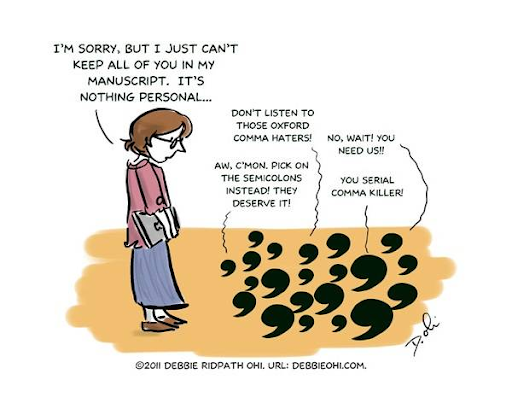
Commas and semicolons aren’t a mystery to be unraveled. They have specific uses. I’ve included a crash course with all of the rules below. If your sentence doesn’t fit one of these situations, you do not need to use a comma or semicolon.

If you’ve ever wondered when to use a comma, here you go:

  1. Commas separate two independent clauses joined by a coordinating conjunction (FANBOYS).
    • Ex. Harvey was a great man, and Leslie was an amazing woman.
  2. Commas separate items in a series. 
    • Ex. You need nuts, bolts, and screws.
  3. Commas are used after introductory phrases of more than two words.
    • Ex. By four in the afternoon, traffic is scary on the bridges.
  4. Commas separate dependent clauses at the start of the sentence from the independent clause.
    • Ex. Because her alarm clock was broken, she overslept and missed the bus.
  5. Commas are used to set off transitional expressions.
    • Ex. Ferns, for example, need less light than other plants.
  6. Commas also set off parenthetical elements. 
    • Ex. By the way, did you see Jim today?
  7. Commas set off appositives (phrases which rename nouns or pronouns).
    • Ex. Judy, our new pitcher, was late to the playoff game.
  8. One word appositives are not set off when they are essential to the meaning of the sentence.
    • Ex. The poet Shelly wrote “Ode to the West Wind.”  The poet’s wife, Mary, wrote Frankenstein.
  9. Commas are used with nonrestrictive relative clauses (clauses that start with who, which, or that that are not necessary to the meaning of the sentence). 
    • Ex. Raj, who is a part-time aviator, loves to tinker with machines of all kinds.
  10. Commas are not used with restrictive relative clauses (clauses that begin with who, which, or that that are necessary to the meaning of the sentence).
    • Ex. People who do their work efficiently make good students.
  11. Commas are also used between the elements of an address.
    • Ex. Send payment to 300 West Road, Stanford, CT 06860.
  12. Commas also separate the elements of a date. 
    • Ex. The wedding is December 12, 2004.
  13. Do not use a comma with a single-word address or date preceded by a preposition.
    • Ex. He arrived from Baltimore in January and stayed awhile.
  14. Commas are used after answering a question with yes or no. 
    • Ex. No, I do not like this.
  15. Commas are used when addressing someone specific. 
    • Ex. Annie, where did you get your gun?
  16. Commas are needed after interjections like ah, oh, etc. 
    • Ex. Ah, this water is refreshing.
  17. Commas are also used to contrast. 
    • Ex. Harold, not Roy, is my favorite player.

 If you’ve ever wondered when to use a semicolon, see the rules below:

  1. Use a semicolon to connect two complete sentences that contain closely related ideas.
    • Ex. The concert was brilliant; the crowd gave the band a standing ovation.
    • Ex. I said I’d do it; I didn’t say when I’d do it. 
  2. Use a semicolon to separate a series of items if the items are long or if they contain commas.
    • Ex. The Millenium Falcon blasted out of Mos Eisley with Obi-Wan Kenobi, the Jedi Master; Luke Skywalker, the untried farm boy; Han Solo, the scoundrel; and Chewbacca, the hairy co-pilot on board.
  3. Use a semicolon to separate two complete sentences joined with transitional phrases (on the other hand, in fact, for example).
    • Ex.  The Force only works on the weak minded; for example, the stormtroopers whom Obi-Wan tricks into thinking their droids weren’t the ones they were looking for are easily fooled.
  4. Use a semicolon to separate two complete sentences joined with conjunctive adverbs such as also, anyway, finally, hence, however, instead, next, therefore, and thus.  
    • Ex. The cantina was filled with alien life forms; however, the two droids were not allowed inside.

Too confusing? Here’s the short version:

  1. Use a comma for lists of more than three items.
    • a. I made a list, checked it twice, and decided I was nice.
  2. Use a comma between two complete sentences joined by any of these words: for, and, nor, but, or yet, so.
    • a. I made the nice list, and I am sure Santa would agree.
    • b. Evelyn was thrilled to see presents under the tree, but her favorite gift was playing in the snow.
  3. Use a comma if you have started a sentence with words that don’t contain the subject (the thing doing the action), put a comma before the subject.
    • a. Because I enjoy the winter, Christmas is my favorite holiday.
    • b. Yes, I will be traveling this holiday season.
  4. If you can remove the words and not change the meaning of the sentence, put them inside commas (yes, on both sides—one before the first word and one after the last word).
    • a. I will, of course, happily join your writer’s group.
    • b. John, one of my favorite writers, publishes a new book every six months.

A Note on the Oxford Comma

The Oxford Comma matters. That is all (except it isn’t… because here I go: <start rant>).

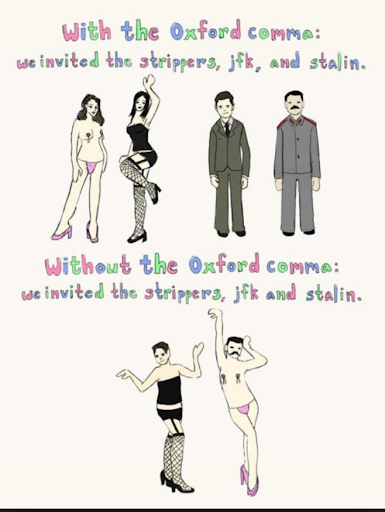
  • The Oxford Comma is the comma before the “and” in a list of three or more items. Here’s why it matters:
    • We invited the strippers, JFK, and Stalin to the party.
      • Epic party! You have three (or more?) attendees—strippers, JFK, and Stalin. 
    • We invited the strippers, JFK and Stalin.
      • Umm… JFK and Stalin are the strippers? Yes. When you don’t have a second comma, whatever comes after the first comma is an example of the first thing you listed.

Bottom line: don’t use a comma or semicolon unless you need it!  

Posted on

From the Editor’s Desk: A Guide to Tense

Get ready for a week of Editing Guides! We start with Tense, move into Commas and Semicolons, address Dialogue, cover Weird Punctuation, and end with a discussion of Editing overall.

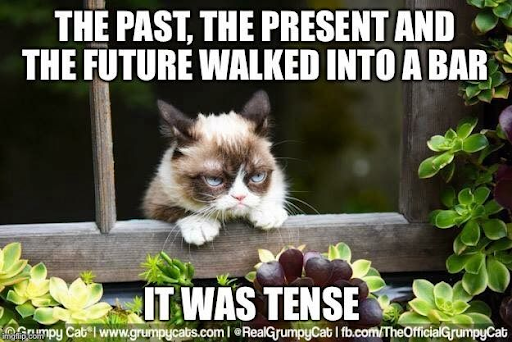
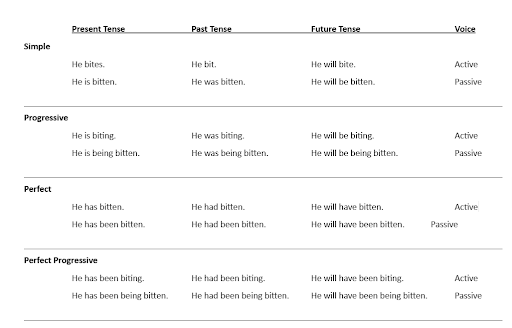
Tense can mean so many different things, but in writing, it specifically refers to the time frame in which a thing happened. When did the verb actually verb? Did it verb earlier? Past tense. Is it verbing right now? Present tense. Will it verb later? Future tense. Seems pretty simple, right? Except this is English, so of course it is way more complicated than that. Rather than turn this blog into a lesson on traditional English verb tense, which actually includes a mind-boggling 12 tenses (24 if you consider active and passive voice separately!), I’ll focus on what this usually means to authors considering how they want to write their next book. 

If you want to hurt your brain learning more about grammar stuff, check out the chart at the bottom of this blog (Yes, you can actually say “He will have been being bitten” and have it actually mean something specific in English–not that anyone wants to say that, or convey the information in that way–but English gives you the option!)

OKay, let’s start with the old standard–past tense. A good chunk of novels and short stories are written in past tense, meaning that the verbs use the past tense ending (-ed, -en, -d). The story would say: Elizabeth Bennet blushed, thinking of how Darcy held her hand as she got in the carriage (Not: Elizabeth Bennet blushes). The story recounts events that have already happened. Benefits of this tense are first that it’s easy to use consistently since we often speak in past tense (and default to it even when we don’t intend to). Past tense is reliable and consistent. One downfall is if you are writing in 1st person, though. A past tense 1st person story means that the narrator survived their ordeal to tell the tale after the fact, so spoiler alert! Do keep in mind that any internal thoughts the characters have are always in present tense, even if the narrative is in past tense (I wonder why Mr. Darcy is such a jerk, Elizabeth thought, frowning as she braided her long hair). 

Speaking of present tense, this is becoming more common outside of the romance novels where it reigns supreme. Present tense means that the action is happening in the moment as readers are reading it. Both thoughts and the narrative can be in present tense, but it can get sticky in moments when the narrative recounts a previous event in the moment. For instance, thinking of Lizzie Bennet, we can say this: Elizabeth Bennet blushes, thinking of how Darcy held her hand as she got in the carriage. As is, Lizzie is blushing, thinking of a past event. This is fine in a present tense novel–but that’s not all. You have options! You can have Lizzie think about Darcy in the moment that he touches her hand: Elizabeth Bennet blushes, thinking of Darcy holding her hand as she gets in the carriage OR Elizabeth Bennet blushes, thinking of how Darcy holds her hand as she gets in the carriage. Consider genre expectations when choosing present tense–and doublecheck that you don’t slip back into past tense without cause (like recounting a past event in the present moment). 

That leaves future tense, but very little fiction outside of speculative and experimental pieces use this tense to tell a story. When they do, it tends to be very bossy: Elizabeth Bennet will blush, thinking of Darcy will hold her hand when she gets in the carriage. Will she, then? Future tense seems to demand action of the characters, which makes it awkward to maintain for long period of time. It’s like writing in 2nd person (you)–fun for a little while but ultimately challenging to maintain.

When considering tense for your story, think about the genre expectations as well as your own preferences. Going through a novel to change every single verb tense is not a good time, so it’s better to have your tense decided from the start. If in doubt, write the same scene in both tenses and see which one feels better–then maintain that for the rest of the story. 

As for me, I will have been being enchanted by Darcy and Lizzie by the time I finish this blog. Yeah, there’s a reason we don’t use passive future perfect progressive tense very often!

Posted on

Release Day: Extinction Event

We are excited for the release of Extinction Event by Maria DeVivo!

Griffin’s luck may have finally run out—for good.

After escaping their imprisonment on Plum Island, Griffin and Jarrod return to the mainland only to find that a second outbreak of the virus is ravaging the entire country. Only this time, help isn’t on the way.

Their only chance of survival is to get back to Dr. Oswald’s lab in Florida, where a unique Altered child could hold the key to a cure. Except, even if Griffin can find his way home, it may be too late to save mankind from its extinction event.

You can order this book  in all formats directly from our 4HP Website and receive 10% OFF using coupon code 4HP10!

Posted on

Release Day: Plague Within

We are excited for the release of Plague Within by Maria DeVivo!

In a post-outbreak society, Griffin may have more enemies than friends.

Two years after the closing of the Altered Re-Assimilation Centers across the United States, Griffin King is trying to rejoin a vengeful society still nursing its wounds. Even though he has been ostensibly cured, no one is eager to trust an infected-turned-altered.

While various forces align against the Altered, a new breed called the Ferals look to bring about a second wave of the virus via a black market drug known as The Black Death. Compelled to continue the work left behind by his former caretaker, Dr. Holston, Griffin must decide who he can trust. But in a fractured landscape on the verge of war, how can Griffin be sure who is friend and who is enemy?

You can order this book  in all formats directly from our 4HP Website and receive 10% OFF using coupon code 4HP10!

Posted on

Release Day: The Altered

We are excited for the release of The Altered by Maria DeVivo!

When the outbreak ends, Griffin must atone for what he’s done in the name of hunger.

Griffin King is an ordinary high school senior dealing with typical teenage issues: a bratty little sister, overbearing parents, an obnoxious best friend, and the unrequited love of his long-time crush. But when a virus chews through a large portion of the population, Griffin soon finds himself on the wrong side of a horror story. After being attacked by an infected, he loses his identity—his only desire is to consume human flesh.

After months of the infected roaming the broken landscape of the city, a cure is found and a mass injection of antiserum is administered to the horde. Griffin finds himself one of the Altered, a small group of “ex-infecteds” who have been cured, but irreparably changed. Now he must learn how to restart his life in an angry post-apocalyptic society where race, gender, and religion don’t matter anymore. Welcome to the new world. A world where people like him—people altered like him—are the minority.

You can order this book  in all formats directly from our 4HP Website and receive 10% OFF using coupon code 4HP10!

Posted on

Release Day: Captain Cutthroat’s Revenge

We are excited for the release of Captain Cutthroat’s Revenge by Joe Davison!

Team Adventure Club is at it again!

Join Carrie Calusa, Leanne McCallister, and Robbie Whitman in another amazing tale of high-flying adventure that’s sure to leave you holding on for dear life.

This time it’s high stakes on the high seas. After finding a treasure map penned by the mysterious Captain Cutthroat, Robbie wants nothing more than to find the treasure and a pirate ship. After convincing Carrie and Leanne, they set out on their state-of-the-art jet skis to a lost volcanic island in the middle of the ocean. Soon, they discover that Captain Cutthroat and his ship the Blasted Dragon are, in fact, real and …alive!The 200-year-old Captain Cutthroat has been cursed to live on his doomed ship forever.

Meanwhile, their arch-nemesis Sir Oliver Hedgestone is after the lost gold too. Now it’s up to Team Adventure Club to protect the fearless pirate and all of his treasures. Can they get the ship to safety before Sir Oliver Hedgestone destroys it and takes all the gold?

After all, it’s just another weekend for Team Adventure Club.

You can order this book  in all formats directly from our 4HP Website and receive 10% OFF using coupon code 4HP10!

Posted on

Release Day: Games and Goblins

We are excited for the release of Games and Goblins by Alan Berkshire!

Toys will be toys!

Thirteen-year-old Jonathan Foster is a dedicated miniature model-maker, specializing in fantasy and comic book characters. While his down-to-earth father wishes his son would find a less solitary interest, Jonathan resists.

Out on a walk after an altercation with his father, Jon finds a deposit of unusual sparkling mud in a stream. Feeling it might be of use, he uses it to mold a goblin. He finds that the model has an unusually brilliant finish and looks uncannily realistic. Though, there’s definitely a vague air of menace about it when it comes to life.

The next thing he knows, the goblin creates a miniature army of models who begin wreaking havoc on Jon’s life since they are not opposed to taking lives in the most brutal fashion. Discovering that the goblin model is the general of this hostile army, Jon must return to the source to find answers so that he can save those closest to him.

You can order this book  in all formats directly from our 4HP Website and receive 10% OFF using coupon code 4HP10!

Posted on

Release Day: Swango

We are excited for the release of Swango by Lou Kemp!

A magician, a widower, and an automat travel the world… but nothing has prepared them for Swango.

In 1870s Singapore, Celwyn survives a vicious attack only to find it may take even more to endure his own family. His brother Pelaez has returned, insisting on his innocence, and their father Wolfgang Augustus Griffin has his sights set on Nemo’s marooned crew. As the Nautilus travels to Beirut, Prague, and Findbar Island, they encounter Swango, a seemingly innocent clairvoyant and drinking buddy from the magician’s past, a man who has more help with his predictions than most spiritualists. Meanwhile, Nemo must finally confront the secrets of his own past.

You can order this book  in all formats directly from our 4HP Website and receive 10% OFF using coupon code 4HP10!